One of the most important things to consider when selecting ESD plastic materials is their electrical resistivity.
AHD's factory test provides a surface resistance range of:
10⁶–10⁹ Ω
The range is measured by means of a hand-held surface resistance tester. It serves as an in-house reference for the evaluation of electrical characteristics of supplied material.
Do not confuse surface resistance with volume resistance or volume resistivity. These properties describe different measurement conditions for the electrical measurement. They are not interchangeable.
The formulation, surface condition, test equipment, electrode configuration, applied voltage, temperature and relative humidity of an ESD material may affect the actual electrical performance.
It is recommended that buyers who require stringent ESD control verify the required resistance range and ask for test information under agreed measurement conditions.
AHD ESD Nylon Sheet Specification
AHD offers ESD Nylon Sheet for industrial material buyers, CNC machining companies and manufacturers who need custom engineered plastic parts.
| Product Specification |
Details |
| Product Name |
ESD Nylon Sheet |
| Thickness |
8–100 mm |
| Standard Sheet Size |
620 × 1220 mm |
| Surface Resistance |
10⁶–10⁹ Ω |
| Testing |
Factory in-house handheld surface resistance tester |
| Material Base |
Nylon-based ESD material |
CNC Custom Machining and Cutting
The projects are different, so the sheet sizes and the component designs differ. AHD can discuss custom cutting and machining requirements based on the drawings and specifications provided by the customer.
The available services can be confirmed according to the project requirements:
Cutting sheets to size
Inquiries about custom thickness and size
Drilling and CNC milling
Custom machining of industrial components
Delivery of Bulk Materials
For precision applications, buyers are encouraged to submit drawings, required tolerances and electrical resistance specifications prior to ordering.
Si está interesado en explorar otros productos de nailon antiestático, tenga en cuenta que, como distribuidor autorizado de Mitsubishi, también podemos suministrarle la lámina de nailon antiestático de Mitsubishi, MC501CD R6. For more information about this product, please click the link
What is MC501CD R6 Sheet? Nailon ESD PA6? ¿Qué significa R6? 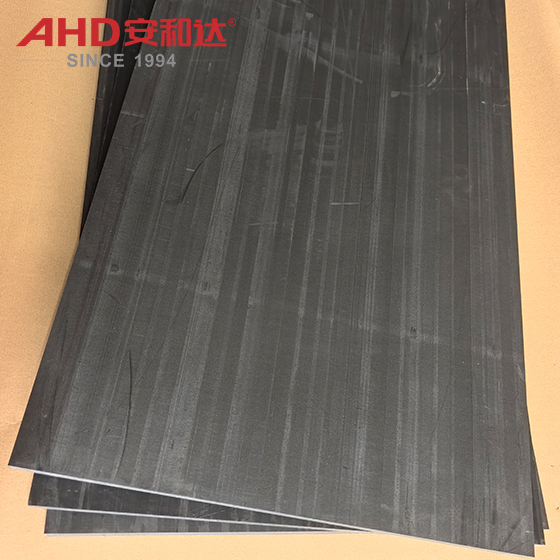
ESD Nylon vs ESD POM: Which Material Should You Choose?
ESD Nylon, ESD POM are two choices of engineering plastics for static control applications. Both can be altered to give a specific electrical resistance characteristic, but the properties of the base material are different.
| Comparison |
ESD Nylon |
ESD POM |
| Base material |
Nylon / Polyamide |
Polyoxymethylene |
| Mechanical characteristics |
Good toughness and mechanical strength |
Good stiffness and dimensional stability |
| Wear performance |
Good wear resistance |
Good wear and sliding properties |
| Moisture absorption |
Relatively higher |
Relatively low |
| Dimensional stability |
Moisture-related changes should be considered |
Generally more stable in humid environments |
| Machining |
Suitable for CNC machining |
Suitable for precision CNC machining |
| Typical applications |
Fixtures, mechanical supports and wear components |
Precision parts, guides and automation components |
The difference is not just electrical resistance, as both materials are available in different ESD formulations.
When to Consider ESD Nylon Choose ESD nylon when the application calls for a combination of mechanical toughness, wear performance and static-control properties. It can be used for fixtures, supports and functional parts that are loaded by mechanical loads.
When to consider ESD POM: ESD POM may be preferred where low moisture absorption, dimensional stability and precise component geometry are important. It is widely used for precision machined parts and sliding components.
Mechanical Characteristics and CNC Machining
In addition to electrical performance, the mechanical properties and machining behavior are also important factors in the selection of an ESD Nylon Plate for industrial components.
Nylon engineering plastics are used extensively in mechanical applications because of their combination of strength, toughness, wear resistance and machinability.
CNC machining of ESD nylon sheet may be considered to:
Control of electronic component fixtures
Mounting elements and support plates for equipment
Assembly fixtures and positioning jigs
Mechanical guides and slidable members
Custom machined industrial components
Machining parameters should be selected for thick plastic plates based on the material grade, component geometry and dimensional tolerances required.
Nylon is also sensitive to humidity. It is hygroscopic and this can affect its dimensions and machining accuracy, particularly for precision components with small tolerances. Machinists should consider material conditioning, machining sequence, cooling and dimensional inspection in production planning.
Industrial Applications of ESD Nylon Sheet
ESD nylon sheet is an option for industrial environments where static control is as critical as mechanical functionality.
1. Equipment for Making Electronics
ESD nylon can be machined into fixtures, supports and components of equipment used around the electronic assembly processes. Its electrical resistance properties make it a potential alternative to conventional insulating plastic parts where static control is needed.
2. Fixtures for Handling Electronic Components
Custom machined trays, holders and positioning fixtures may be useful in organizing and supporting components during manufacturing, inspection and handling operations. Component sensitivity and the required ESD control level must guide the selection of materials.
3. Semiconductor and Automation Equipment
Precision machined plastic components are widely used in automation systems for the positioning, guiding and supporting of components. ESD nylon can be considered for some mechanical parts and fixtures where the electrical properties meet the requirements of the equipment.
4. CNC Machined Industrial Components
Thick ESD nylon plates can be machined to custom shapes, mounting blocks, support structures and other functional parts. It allows manufacturers to manufacture components from specific drawings and dimensional specifications.
FAQ about ESD Nylon Sheet
ESD Nylon is specifically designed to offer controlled electrical resistance and help reduce static charge build-up. Standard nylon is generally electrically insulating and does not necessarily have the static-control properties required in electronics manufacturing. ESD Nylon is therefore a suitable choice for selected fixtures, equipment components and machined parts where static control is important.
AHD Anti Static Nylon Plastic Sheet has surface resistance of 10⁶-10⁹ Ω (tested in factory by handheld surface resistance tester). Actual readings may vary with test conditions such as humidity, temperature and measurement setup. Please contact AHD for confirmation of the applicable test conditions and resistance range for applications with specific ESD requirements.
Yes. The ESD Nylon Sheet can be machined by CNC milling, drilling and other conventional plastic machining processes. It can be made into custom fixtures, positioning blocks, equipment supports and industrial parts. For precision parts, machining parameters and dimensional tolerances should reflect nylon's moisture absorption and potential dimensional changes.






 Contactar ahora


